

Most believers have had seasons when faith felt warm and alive, and other seasons when it slowly cooled without anyone noticing, including themselves. Church becomes a habit, prayer becomes a quick list, and the Bible stays on the shelf. Being a lukewarm Christian rarely starts with a big decision. It usually starts with small drift.
Jesus spoke about this drift directly. Below, we look at what the Bible says about lukewarm faith, the signs to watch for, and how to come back to a wholehearted walk with God.
The Lukewarm Christian Verse: Revelation 3:14-22
The main lukewarm Christian verse is found in the risen Christ’s letter to the church in Laodicea, the last of the seven letters in Revelation 2 and 3. Jesus says:
“I know thy works, that thou art neither cold nor hot: I would thou wert cold or hot. So then because thou art lukewarm, and neither cold nor hot, I will spue thee out of my mouth” (Revelation 3:15-16, KJV).
The Revelation 3:16 meaning is sobering. Jesus is not describing people who openly reject Him. He is speaking to a church. Their problem was not loud rebellion. It was a faith with no real heat.
The Church of Laodicea and the Picture Behind “Lukewarm”
The church of Laodicea met in a wealthy city in what is now Turkey. Across the valley stood Hierapolis, a city known for its hot springs, while Laodicea brought its own water in by aqueduct, and that water was heavy with minerals, according to the remains archaeologists have studied (Laodicea on the Lycus). Many Bible teachers believe the first readers would have understood the image at once: water that is neither hot enough to heal nor cold enough to refresh.
The church also had a blind spot. “Because thou sayest, I am rich, and increased with goods, and have need of nothing; and knowest not that thou art wretched, and miserable, and poor, and blind, and naked” (Revelation 3:17, KJV). Comfort had made them feel self-sufficient. That is often the soil where lukewarm faith grows.
Signs of a Lukewarm Christian
These signs of a lukewarm Christian are meant for honest self-examination, not for judging the person in the next pew. Paul tells us, “Examine yourselves, whether ye be in the faith” (2 Corinthians 13:5, KJV).
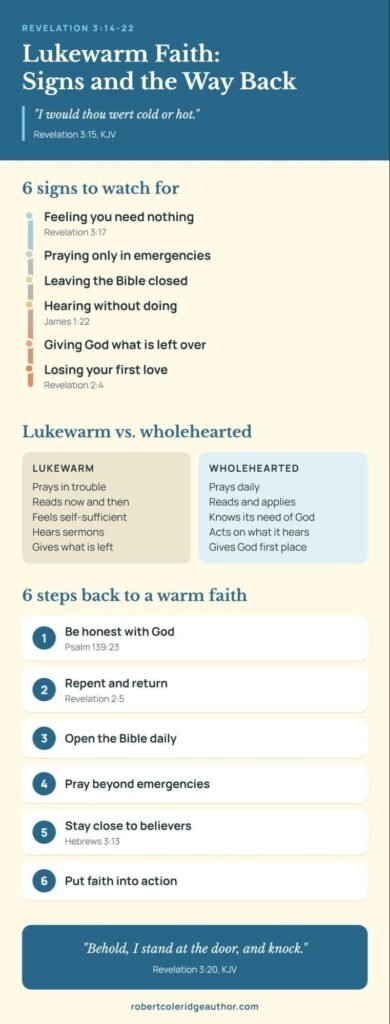
- Feeling that you need nothing. Like Laodicea, you rarely feel your need for God when life is going well.
- Prayer only in emergencies. You talk to God when there is a crisis, but not in ordinary days.
- A closed Bible. Days or weeks pass without opening God’s Word.
- Hearing without doing. James warns against being “hearers only, deceiving your own selves” (James 1:22, KJV).
- A faith that fits around everything else. God gets what is left of your time, money and attention.
- A lost first love. Jesus told the church in Ephesus, “thou hast left thy first love” (Revelation 2:4, KJV).
Here is a question worth sitting with: if Jesus wrote a short letter to you this week, would He describe your faith as hot, cold or lukewarm?
Lukewarm Faith vs. Wholehearted Faith
The difference usually shows in small, everyday choices.
| Lukewarm faith | Wholehearted faith |
|---|---|
| Prays when there is trouble | Prays as a daily habit |
| Reads the Bible now and then | Reads and applies the Bible regularly |
| Feels self-sufficient | Knows its daily need for God |
| Hears sermons | Acts on what it hears |
| Gives God what is left | Gives God first place |
Why Jesus Warns Lukewarm Believers So Strongly
The warning in Revelation 3 is hard to read, but it comes from love. Jesus says, “As many as I love, I rebuke and chasten: be zealous therefore, and repent” (Revelation 3:19, KJV). He is not writing off this church. He is calling it back.
Then comes one of the most tender verses in the Bible: “Behold, I stand at the door, and knock: if any man hear my voice, and open the door, I will come in to him, and will sup with him, and he with me” (Revelation 3:20, KJV). The cure for lukewarm faith is not trying harder on your own. It is opening the door to Christ again and enjoying fellowship with Him.
How to Stop Being a Lukewarm Christian
If you see yourself in this passage, take heart. Conviction is a sign that God is still at work. Here are practical steps for how to stop being a lukewarm Christian:
- Be honest with God. Pray, “Search me, O God, and know my heart” (Psalm 139:23, KJV). Name where you have drifted.
- Repent and return. Jesus told Ephesus to “remember therefore from whence thou art fallen, and repent, and do the first works” (Revelation 2:5, KJV). Go back to the simple things you did when your faith was fresh.
- Open the Bible every day. Start small, even one chapter. If you are not sure where to begin, this guide on how to study the Bible effectively can help.
- Pray beyond emergencies. Use Scripture to shape your prayers, as explained in how prayer and Scripture work together.
- Get close to other believers. “But exhort one another daily, while it is called To day; lest any of you be hardened through the deceitfulness of sin” (Hebrews 3:13, KJV).
- Put your faith into action. Serve someone this week. Faith grows warmer when it is used.
A Resource for Fighting Lukewarm Faith: Sola Scriptura Topical Bible Study
The danger of becoming a lukewarm Christian is one of the topics Robert Coleridge addresses in Sola Scriptura: Topical Bible Study. The series is arranged by theme, so you can study what the whole Bible says about drifting, repentance and renewed devotion, and apply it to daily life.
Conclusion
A lukewarm Christian is not beyond hope. The same letter that warns Laodicea also shows Jesus standing at the door and knocking. Start today with an honest prayer, an open Bible and one step of obedience. For a guide to going deeper in God’s Word, explore Sola Scriptura: Topical Bible Study by Robert Coleridge.
Frequently Asked Questions
Q1: What does the Bible say about lukewarm Christians?
The clearest passage is Revelation 3:14-22. Jesus tells the church in Laodicea that their faith is “neither cold nor hot” and warns them, but He also calls them to repent and promises fellowship to anyone who opens the door.
Q2: What is the meaning of Revelation 3:16?
It means that a half-hearted, comfortable faith is distasteful to Christ. The verses that follow show that His goal is to bring the church back.
Q3: Can a lukewarm Christian be saved?
Christians discuss this question in different ways. What the passage makes clear is that lukewarmness is dangerous and should not be ignored. The right response is to examine yourself honestly (2 Corinthians 13:5) and return to Christ, who is still knocking.
Q4: What are the signs of lukewarm faith?
Common signs include feeling self-sufficient, praying only in a crisis, rarely reading the Bible and hearing God’s Word without acting on it.
Q5: How do I get my passion for God back?
Go back to the basics: honest prayer, daily Scripture, fellowship and simple obedience. Passion often returns as you take these steps, not before.