Maybe you moved to a new town. Maybe you have been away from church for years and want to come back. Or maybe your old church changed, and you are not sure where you belong. Whatever brought you here, knowing how to choose a church is one of the most important decisions a believer can make, because the church you join will shape how you grow in Christ.
Fewer Americans belong to a church than in the past. Gallup found that in 2020, 47% of U.S. adults belonged to a church, synagogue or mosque, down from 70% in 1999 (Gallup). Yet the Bible never pictures a Christian walking alone. This guide will help you choose a church with Scripture as your filter.
Why Church Still Matters
The New Testament describes the church as a family and a body, not a building. “Now ye are the body of Christ, and members in particular” (1 Corinthians 12:27, KJV). A hand cannot grow apart from the body, and a believer is not meant to grow apart from other believers.
Hebrews puts it plainly: “Not forsaking the assembling of ourselves together, as the manner of some is; but exhorting one another: and so much the more, as ye see the day approaching” (Hebrews 10:25, KJV). Church is where we are taught, encouraged, corrected and sent out to serve.
What to Look for in a Church: Marks of a Healthy Church
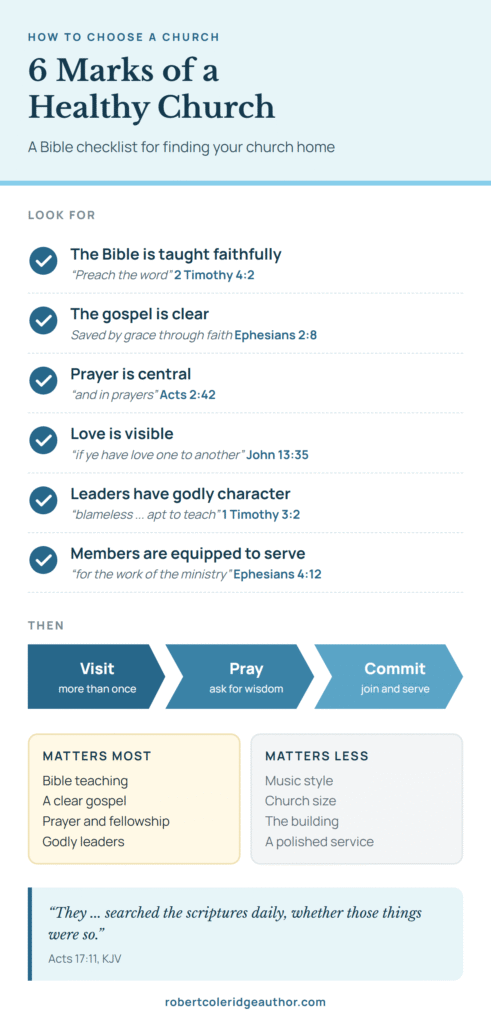
The first believers give us a simple picture: “And they continued stedfastly in the apostles’ doctrine and fellowship, and in breaking of bread, and in prayers” (Acts 2:42, KJV). From that verse and the rest of the New Testament, here are the signs of a healthy church:
- The Bible is taught faithfully. Paul told Timothy, “Preach the word” (2 Timothy 4:2, KJV). Look for sermons that explain what a passage actually says and show how to live it.
- The gospel is clear. You should hear that we are saved “by grace … through faith” in Christ (Ephesians 2:8, KJV), not by good works or church membership.
- Prayer is central. A praying church depends on God, not on programs.
- Love is visible. “By this shall all men know that ye are my disciples, if ye have love one to another” (John 13:35, KJV).
- Leaders have godly character. Scripture asks leaders to be “blameless,” “of good behaviour” and “apt to teach” (1 Timothy 3:2, KJV).
- Members are equipped to serve. Leaders are given “for the perfecting of the saints, for the work of the ministry” (Ephesians 4:12, KJV).
Questions to Ask Before You Commit
When you visit, it helps to come with a few questions. These are useful whether you talk to a pastor, a greeter or a small group leader:
- What does this church believe? Ask for the statement of faith and read it carefully.
- How do you preach? Through books of the Bible, or topic by topic?
- How are new believers discipled and helped to grow?
- Are there small groups or Bible studies during the week?
- How are members cared for when they are sick or struggling?
- Who are the leaders accountable to?
Many churches post sermons online. Listening to several before your visit, or after it, is a simple way to follow the example of the Bereans, who “searched the scriptures daily, whether those things were so” (Acts 17:11, KJV).
What Matters Most and What Matters Less
It is easy to choose a church for the wrong reasons. This table can help you keep first things first.
| Matters most | Matters less |
|---|---|
| Faithful Bible teaching | Music style |
| A clear gospel | Size of the congregation |
| Prayer and real fellowship | The building and facilities |
| Leaders with godly character | How polished the service feels |
| A place where you can serve | Whether you know people there yet |
Preferences are not wrong. Kids’ ministry, distance from home and worship style can matter for your family. They just should not outrank the things Scripture puts first.
Warning Signs to Watch For
Paul warned that “the time will come when they will not endure sound doctrine; but after their own lusts shall they heap to themselves teachers, having itching ears” (2 Timothy 4:3, KJV). Be careful if you notice:
- The Bible is quoted a little but rarely explained.
- The gospel is missing, or replaced by self-help or politics.
- Leaders answer to no one.
- Members are pressured, shamed or controlled.
- Money is emphasized more than Christ.
No church is perfect, because every church is made of forgiven sinners. The goal is not a flawless church but a faithful one.
Visit, Pray, Then Commit
Choosing a church is a decision to bring to God. “If any of you lack wisdom, let him ask of God, that giveth to all men liberally” (James 1:5, KJV). Visit more than once, attend a small group if you can, and give it some time. Then, when you have found a church that holds to God’s Word, commit. Join, serve and let people know you.
What is the one thing you most need from a church family right now: teaching, friendship, accountability or a place to serve? Let that guide your prayers as you visit.
A Resource for Growing in Your New Church: Sola Scriptura Topical Bible Study
Questions such as how to choose a church as a Christian are among the topics in Sola Scriptura: Topical Bible Study by Robert Coleridge. Because it is arranged by theme, it is easy to use on your own or with a new small group as you settle into a church family.
Conclusion
The right church is not the one with the best coffee or the biggest stage. It is a church where God’s Word is taught, the gospel is clear, people pray and love one another, and you are helped to grow and serve. Ask God for wisdom, test what you hear by Scripture, and then commit with your whole heart. For a Bible-centered study to grow with, explore Sola Scriptura: Topical Bible Study by Robert Coleridge.
Frequently Asked Questions
Q1: How do I choose a church according to the Bible?
Look for faithful Bible teaching, a clear gospel, prayer, genuine love among members, leaders of godly character and opportunities to serve. Acts 2:42 is a helpful starting point.
Q2: How many times should I visit before deciding?
There is no set number in Scripture. Many people find it helpful to visit several Sundays and attend a midweek group before deciding, so they see more than one service.
Q3: Is online church enough?
Online sermons can be a blessing, especially for people who cannot attend in person. But the New Testament pictures believers meeting together, serving and caring for one another (Hebrews 10:24-25), which is hard to do from a screen alone.
Q4: Does the denomination matter?
What matters most is what a church teaches about the Bible, the gospel and Christ. Read the church’s statement of faith rather than relying on its name alone.
Q5: Is it okay to leave a church?
Sometimes moving or serious problems with teaching make it right to leave. When possible, pray first, talk with the leaders honestly and leave peacefully, without gossip.