

Every day, believers hear dozens of voices about God, life and right and wrong. Sermons, podcasts, short videos, friends and our own feelings all speak at once. Some of it is true, some of it is half true, and some of it is simply wrong. Biblical discernment is the God-given ability to tell the difference, and the good news is that it can grow.
In this article, we will look at the meaning of discernment in the Bible, why it matters, how it differs from being judgmental, and practical ways to grow in it.
Biblical Discernment Meaning
The simplest biblical discernment meaning is this: seeing people, ideas and choices the way God sees them, so we can hold on to what is good and reject what is not. Discernment is more than being smart or suspicious. It is spiritual wisdom shaped by God’s Word.
When King Solomon could have asked God for anything, he asked for discernment: “Give therefore thy servant an understanding heart to judge thy people, that I may discern between good and bad” (1 Kings 3:9, KJV). Paul prayed that believers’ love would grow “in knowledge and in all judgment; That ye may approve things that are excellent” (Philippians 1:9-10, KJV). Discernment is not only telling right from wrong. It is also choosing what is best over what is merely acceptable.
Discernment in the Bible Grows With Practice
Discernment in the Bible is described as a skill that matures. “But strong meat belongeth to them that are of full age, even those who by reason of use have their senses exercised to discern both good and evil” (Hebrews 5:14, KJV). Notice the words “by reason of use.” Just as muscles grow stronger through exercise, discernment grows as we keep applying God’s Word to real situations.
It is also a work of the Holy Spirit. Paul explains that the things of God “are spiritually discerned” (1 Corinthians 2:14, KJV). We grow in discernment as we walk closely with the Lord, not only by collecting information.
Why Spiritual Discernment Matters Today
The Bible tells us to expect false teaching. “Beloved, believe not every spirit, but try the spirits whether they are of God: because many false prophets are gone out into the world” (1 John 4:1, KJV). Jesus warned of false prophets “in sheep’s clothing” and said, “Ye shall know them by their fruits” (Matthew 7:15-16, KJV).
Spiritual discernment protects us from teaching that sounds Christian but leads away from Christ. It also helps with ordinary choices: which friendships to build, which opportunities to take, and what to let into our minds.
So here is a question for you: where in your life do you most need discernment this week, in what you are hearing, in a relationship or in a decision?
Discernment vs. Judgment
Many people quote “Judge not, that ye be not judged” (Matthew 7:1, KJV) to say Christians should never evaluate anything. But Jesus also said, “Judge not according to the appearance, but judge righteous judgment” (John 7:24, KJV). The difference lies in the heart and the standard.
| Biblical discernment | A judgmental spirit |
|---|---|
| Measures ideas by Scripture | Measures people by personal preference |
| Aims to protect and restore | Aims to win or look superior |
| Starts with self-examination | Starts with pointing at others |
| Speaks “the truth in love” (Ephesians 4:15) | Speaks harshly or not at all |
| Stays humble and teachable | Assumes it is always right |
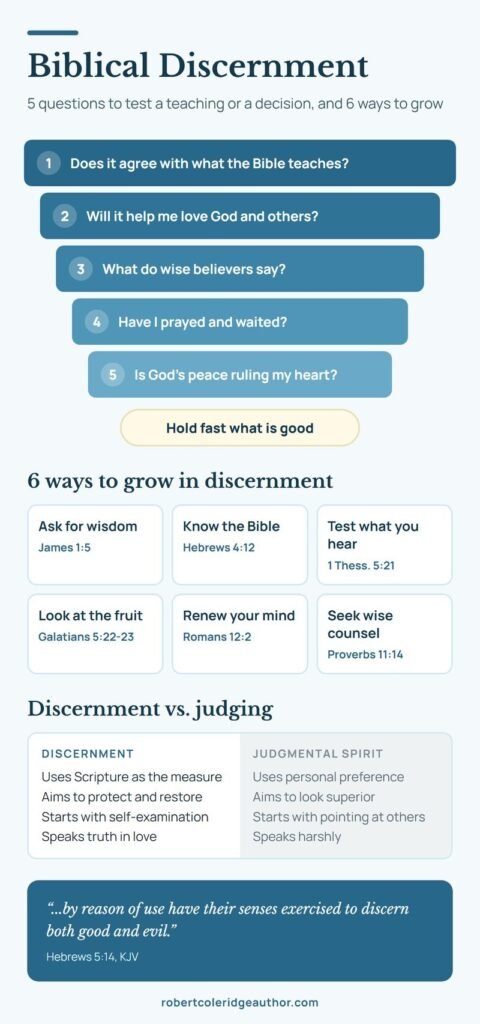
How to Grow in Discernment: 6 Practices
If you are wondering how to grow in discernment, start with these habits:
- Ask God for wisdom. “If any of you lack wisdom, let him ask of God, that giveth to all men liberally, and upbraideth not; and it shall be given him” (James 1:5, KJV).
- Know the Bible well. The Word of God “is a discerner of the thoughts and intents of the heart” (Hebrews 4:12, KJV). The better you know the real thing, the faster you notice a counterfeit. This guide on studying the Bible one topic at a time is a good place to start.
- Test what you hear. “Prove all things; hold fast that which is good” (1 Thessalonians 5:21, KJV). Check teaching against Scripture, like the Bereans in Acts 17:11.
- Look at the fruit. Does a teaching or choice produce “love, joy, peace, longsuffering, gentleness, goodness, faith, meekness, temperance” (Galatians 5:22-23, KJV)?
- Renew your mind. “Be not conformed to this world: but be ye transformed by the renewing of your mind, that ye may prove what is that good, and acceptable, and perfect, will of God” (Romans 12:2, KJV).
- Seek wise counsel. “In the multitude of counsellors there is safety” (Proverbs 11:14, KJV). Talk big decisions over with mature believers.
How to Discern God’s Will in Everyday Decisions
Discernment is not only about spotting false teaching. It also helps us discern God’s will in daily choices. A simple set of questions can guide you:
- Does this agree with what the Bible clearly teaches?
- Will it help me love God and others better?
- What do wise, mature believers say about it?
- Have I prayed about it and waited, or am I rushing?
- Does God’s peace “rule in your hearts” about it (Colossians 3:15, KJV)?
Above all, “Trust in the LORD with all thine heart; and lean not unto thine own understanding” (Proverbs 3:5, KJV). Discernment grows best in a heart that is humble before God.
A Resource for Sharpening Discernment: Sola Scriptura Topical Bible Study
Sola Scriptura: Topical Bible Study by Robert Coleridge is written to strengthen faith and sharpen discernment. Because it gathers what Scripture says on each topic in one place, it helps you build the deep familiarity with God’s Word that discernment depends on.
Conclusion
Biblical discernment is not a rare gift for a few experts. It is a skill every believer can grow in by asking God for wisdom, knowing His Word, testing what we hear, watching for good fruit and listening to wise counsel. Start practicing it in one area of your life this week. To grow deeper in Scripture topic by topic, explore Sola Scriptura: Topical Bible Study by Robert Coleridge.
Frequently Asked Questions
Q1: What is biblical discernment?
Biblical discernment is the ability, given by God and shaped by Scripture, to tell truth from error and good from evil, and to choose what is best (Hebrews 5:14; Philippians 1:9-10).
Q2: What Bible verses talk about discernment?
Key verses include 1 Kings 3:9, Philippians 1:9-10, Hebrews 5:14, 1 John 4:1, 1 Thessalonians 5:21 and Romans 12:2.
Q3: Is discernment a spiritual gift?
Paul lists “discerning of spirits” among the gifts of the Spirit in 1 Corinthians 12:10. At the same time, Hebrews 5:14 shows that every believer is called to grow in discernment through practice.
Q4: What is the difference between discernment and judging?
Discernment measures ideas and choices by God’s Word with humility and love. A judgmental spirit measures people by personal standards and looks down on them.
Q5: How can I grow in discernment quickly?
There is no shortcut, but daily Bible reading, prayer for wisdom, testing what you hear against Scripture and seeking wise counsel will help you grow steadily.