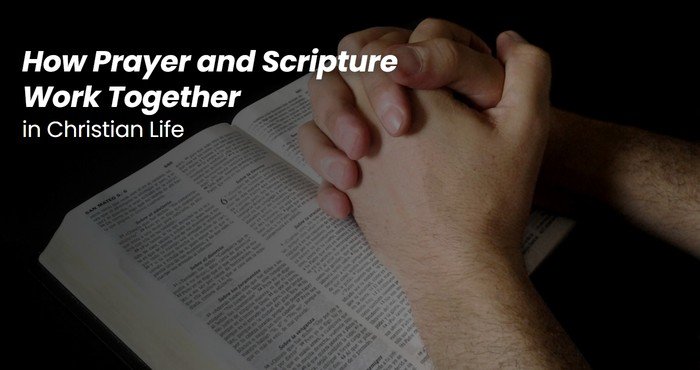
How Prayer and Scripture Work Together in Christian Life
Many believers treat Bible reading and prayer as two separate tasks on a spiritual checklist. We read a chapter in the morning, we bow our heads later in the day, and the two rarely meet. Yet prayer and scripture were never meant to live apart. In the Bible, God speaks through His Word, and His people answer Him in prayer. When the two come together, a quiet routine becomes a real conversation.
This article looks at why they belong together, what the Bible shows us about praying God’s Word, and simple ways to join them in everyday life.
Why Prayer and Scripture Belong Together
Think of any close friendship. It grows when both people speak and both people listen. Our relationship with God works in a similar way. In Scripture, God speaks. In prayer, we respond, ask, confess and give thanks.
Jesus tied the two together in one sentence: “If ye abide in me, and my words abide in you, ye shall ask what ye will, and it shall be done unto you” (John 15:7, KJV). Notice the order. His words abide in us first, and then we ask. Scripture shapes what we pray for, so our requests begin to line up with what God has already said He cares about.
Without the Word, prayer can drift toward our own wishes and worries. Without prayer, Bible reading can become a study of facts that never reaches the heart. Each one keeps the other honest.
The Importance of Prayer in Christian Life
The importance of prayer in Christian life is clear from how often the Bible calls us to it. Paul wrote simply, “Pray without ceasing” (1 Thessalonians 5:17, KJV). He also urged believers to bring every concern to God: “in every thing by prayer and supplication with thanksgiving let your requests be made known unto God” (Philippians 4:6, KJV).
Jesus Himself often withdrew to pray, early in the morning (Mark 1:35) and even through the night (Luke 6:12). If the Son of God made time to speak with the Father, we can be sure we need it too. Prayer is not a way of telling God things He does not know. It is a way of depending on Him.
What the Bible Shows Us About Praying God’s Word
Scripture is full of people who prayed with God’s Word already in their minds. Daniel read the prophecy of Jeremiah about the years of exile, and it moved him to seek God “by prayer and supplications, with fasting” (Daniel 9:2-3, KJV). When the early church faced threats, the believers prayed together and quoted Psalm 2 (Acts 4:24-26). Even on the cross, Jesus cried out the opening words of Psalm 22: “My God, my God, why hast thou forsaken me?” (Matthew 27:46, KJV).
Praying with Scripture is not a modern technique. God’s people have always borrowed His words when their own words ran short.
A Simple Way to Pray Through a Passage
You do not need special training to begin. Here is a simple pattern many Christians find helpful:
- Read slowly. Choose a short passage, such as a psalm, and read it more than once.
- Notice what it says about God. Is He faithful, merciful, holy or near? Thank Him for that.
- Turn the words into prayer. If you read “The LORD is my shepherd; I shall not want” (Psalm 23:1, KJV), you might pray, “Lord, thank You for leading me. Help me trust You with what I lack today.”
This is what praying with Bible verses looks like in practice. It also helps to begin with the words of Psalm 119:18: “Open thou mine eyes, that I may behold wondrous things out of thy law” (KJV).
Bible Meditation: Letting the Word Sink In
Bible meditation is not about emptying your mind. In Scripture, meditating means filling your mind with God’s Word and turning it over again and again. The blessed person in Psalm 1 is the one whose “delight is in the law of the LORD; and in his law doth he meditate day and night” (Psalm 1:2, KJV).
Meditation is often the bridge between reading and praying. You think about a verse through the day, and your thoughts slowly turn into prayers. A verse about God’s care may lead to thanksgiving. A verse about sin may lead to honest confession.
Building Christian Prayer Habits That Last
A few simple Christian prayer habits can help you keep the Word and prayer together:
- Pick a set time and place. Any regular time you can protect is a good time.
- Read before you pray. Even five minutes in the Bible gives your prayer something solid to stand on.
- Keep a simple journal. Write down a verse and one line of prayer that grew out of it.
- Carry one verse with you. A verse on a card or in a phone note keeps the conversation going.
The Power of Prayer Rooted in God’s Word
The power of prayer does not come from the person praying or from finding the right words. It comes from the God who hears. James reminds us that “the effectual fervent prayer of a righteous man availeth much” (James 5:16, KJV). When our prayers rest on Scripture, we can pray with confidence, because we are asking for things God has already promised, such as wisdom (James 1:5) and His peace (Philippians 4:7).
That is the heart of connecting with God. He speaks, and we listen. We speak, and He listens.
A Helpful Companion: Sola Scriptura Topical Bible Study
If you want to bring more of God’s Word into your prayer life, it helps to know where Scripture speaks to the things you are praying about. Sola Scriptura: Topical Bible Study by Robert Coleridge arranges Scripture by theme, so you can look closely at what the Bible teaches on a subject and then carry those verses into prayer.
Conclusion
Prayer and the Bible are two halves of one conversation with God. His Word teaches us who He is and what He has promised, and prayer is how we answer Him and grow in trust. Start small. Read a few verses, pray them back to God, and carry one of them with you through the day. For a guided way to explore Scripture by topic, take a look at Sola Scriptura: Topical Bible Study by Robert Coleridge.
FAQs
Q1: How do prayer and scripture work together?
Scripture is how God speaks to us, and prayer is how we respond. The Bible gives our prayers direction, while prayer helps us take what we read to heart.
Q2: How can a beginner start meditating on Scripture?
Choose one short verse, read it slowly several times, and think about what it says about God. Return to it during the day and turn your thoughts into simple prayers.
Q3: Do I need to pray for a long time each day?
The Bible does not set a required number of minutes. A sincere, regular habit matters more than length, and a few honest minutes with God are a good place to start.