What Is Sola Scriptura? Meaning, History & Why Scripture Alone Matters
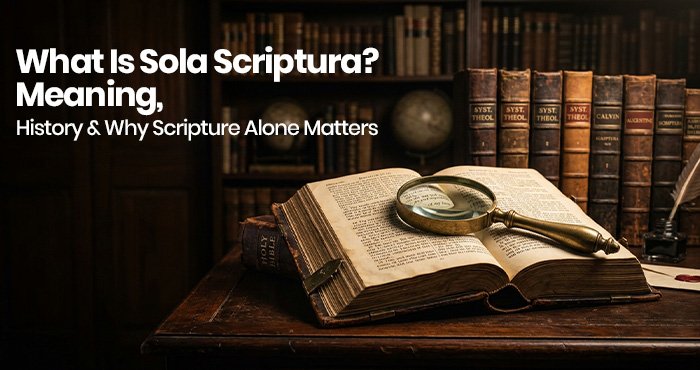
If you have studied Protestant Christianity or church history at all, there is one Latin expression you have definitely run into before; it may not sound like much, but it actually holds a lot of weight – Sola Scriptura. Perhaps you have seen it mentioned in a sermon, a book, or even during your Bible study. Regardless of how you were introduced to this concept, one thing is certain: this is something that deserves to be understood.
But what is sola scriptura anyway? Fundamentally, it is an idea that deals with authority; namely, the conviction that the Word of God, recorded in the form of the Holy Scriptures, is the supreme and ultimate authority when it comes to everything a Christian should believe and do. Not councils of the church. Not tradition or customs. Not clergy. Only Scripture. This article will cover everything you need to know about this idea.
Sola Scriptura Meaning — Breaking Down the Latin
Once you understand what the individual words mean, then it becomes a fairly straightforward phrase. Sola means “alone” while scriptura means “Scripture” or “writing.” Combining the two produces a phrase that is quite concise yet very powerful.
The sola scriptura meaning is not to say that the Bible is the only book that Christians should be reading and that church history has no worth whatsoever. The meaning of sola scriptura is that if there is an issue between what the Bible says and what the tradition, the church councils, and even the leaders of that religion say, the Bible always prevails.
Understanding the scripture alone meaning also means understanding what Scripture is. In the eyes of Christians, the Bible is believed to have been divinely inspired because the words of the Bible were penned by human hands under divine inspiration from the Holy Spirit. This makes the Bible a book that holds an extraordinary form of authority that no other human document can claim.
Where Sola Scriptura Came From — A Brief History
To have sola scriptura explained, one will need to trace back to the sixteenth century, in particular, when an event in church history took place called the Protestant Reformation. During this time, it was already common practice within the Roman Catholic Church for church tradition and doctrines taught by the clergy of the church to be regarded on equal footing or even better than Scripture on certain matters. Christian doctrines and beliefs were mostly decided in councils and papal decisions and not in the Bible itself.
Martin Luther was a German monk who directly confronted this. From 1517, he openly criticized the doctrines of the church, which he felt had no basis in the Scriptures. When church leaders asked him to renounce his statements, he said that he cannot do so unless he is convinced from the Scriptures that he has spoken wrongly. His refusal to recant was an embodiment of sola scriptura in essence.
This was one of the five great “solas” of the Reformation — five Latin mottos which encapsulated the essence of what the reformers believed in. Together, these five mottos stood for the concept of salvation through grace alone, faith alone, in Christ alone, and to the glory of God alone, and all this was based on the Word of God alone. Each motto was an answer to some teaching which the reformers thought was deviating from Biblical truth.
The Bible as the Final Authority — What That Looks Like in Practice
Holding the Bible as the final authority is not just a theological statement —It affects the manner in which Christians conduct themselves and make decisions. Whenever a Christian encounters an ethical dilemma, makes a personal choice, or comes face-to-face with a doctrinal question, he or she will always ask one thing: what does the Scripture teach on this issue?
It does not imply that every believer must learn how to study the Bible properly before being able to serve the Lord. Rather, it implies that answers to the greatest challenges people meet in their lives can only be found in the word of God, and any doctrine that is not based upon what the Scripture teaches should be rejected. The apostle Paul praised the Bereans for their readiness to compare his teachings with the Scripture in Acts 17. That spirit of testing everything against God’s Word is exactly what biblical authority looks like in everyday life.
The importance of scripture shows up in this way — It means that anyone who believes has direct access to the truths of God without requiring an intermediary between the believer and the Word. One does not have to rely on priests to be told the meaning of the Bible. One can study it, pray on it, and with the help of the Holy Spirit, interpret it. This is an incredible freedom, which sola scriptura has provided to believers.
Sola Scriptura vs Tradition — Understanding the Difference
It’s at this point that things get really interesting. Many Christians, especially those raised in a Catholic or Orthodox tradition, will tell you that Scripture and Tradition form the basis of Christian theology. This means that the thousands of years of church tradition and theology have authority too. So what does sola scriptura vs tradition actually mean for believers?
Protestant Christians who believe in sola scriptura, however, do not necessarily dismiss the importance of church history and tradition. They learn from the teachings of church fathers, read many books written in the centuries gone by, and appreciate the teachings of previous generations. The thing is that the sources mentioned above are considered valuable for guidance and knowledge, not for making final decisions about matters of faith.
Here is a comparison of sola scriptura and tradition:
- Tradition — useful as guidance but open to correction by Scripture
- Church councils — useful but not infallible; should be tested according to God’s Word
- Religious leaders — useful for learning but not the last word on truth
- Scripture — only source of truth and God’s word
It is always possible to make the same distinction — when something does not contradict the Scripture, it may be embraced without hesitation. Otherwise, it should be abandoned regardless of its age and popularity among the religious community.
Why Sola Scriptura Still Matters for Christians Today
There are those who ask if a teaching from the sixteenth century is relevant for twenty-first-century Christians. Yes, it might be even more relevant now than ever. We are at the age where everybody seems to have an opinion on God, faith, and morals. New doctrines keep springing up everywhere, and it really becomes difficult to figure out which ones to take seriously.
The doctrine of sola scriptura provides a solid footing for all believers. Regardless of the time in history, regardless of popular beliefs, and regardless of how convincing one particular voice might be, the Word of God as presented by the Bible never changes. It has always been and will always remain the total truth of God. This is something that every generation needs.
The Biblical authority principle also helps to guard the church against drifting, which is evident when tradition, culture, or human leadership takes the place of the Bible as the benchmark of truth. It is evident in history what takes place when the church begins to stray away from the foundations of the Bible – false doctrines are taught, errors are made, and the common people get alienated from the simplicity and truth of the Word of God.
A Companion for Going Deeper — Sola Scriptura Topical Bible Study
However, if you find that this topic has aroused more interest in you and you want to know what is sola scriptura? and other biblical topics in an organized manner, then Sola Scriptura: Topical Bible Study by Robert Coleridge can help.
This series is created on the basis of the very idea behind this doctrine – the belief that the Scriptures themselves are the greatest teachers. Instead of creating opinions based on opinions, this series takes its readers straight to the Word of God and helps to study the most significant topics in an organized and easily comprehensible way. Biblical authority, nature of the Scriptures, Christian doctrines, and their practical usage are among those topics that are considered in this series.
The reason why this series is such a perfect fit for the concepts outlined in this article is that it not only gives an explanation of the concept of sola scriptura but exemplifies it. Each issue is dealt with by looking at the Bible first and letting the Bible speak. If you are looking for a tool that will help you in understanding God’s word and thinking biblically on issues of faith, then this series would be a good choice for you.
Conclusion
Knowing what is sola scriptura goes beyond being just another theological topic. It brings us back to a very personal truth — the fact that God spoke His word to you personally, and that word is sufficient. You do not have to consult countless opinions to know what the truth is. You simply have to consult the Bible, study it diligently, and pray about it, and know that God will reveal Himself in His word.
That is why the reformers fought so hard for it, because they knew — quite correctly — that once the role of the Scripture is diminished, every other aspect of the Christian faith follows suit. It is not outdated to keep the scripture as your sole guide in faith. It is alive, active, and full of God speaking through His word.
Find a good Bible study on Sola Scriptura if you want some more structured guidance on this topic.
FAQs
Q1: What is sola scriptura in simple words?
What is sola scriptura in simple terms? It is the doctrine that the Bible holds the ultimate authority for the Christian faith and way of life. This is to say that neither tradition nor church leaders have any higher power than that which is stated by the Word of God.
Q2: What is the sola scriptura meaning, and where does it come from?
The sola scriptura meaning comes from two Latin words — sola (alone) and scriptura (Scripture). It became an important doctrine of the Protestant Reformation in the 16th century. The reformers, such as Martin Luther, used it to assert that the Bible is the ultimate source of truth for Christians, not the traditions or teachings of the Church.
Q3: What does scripture alone mean for everyday believers?
The scripture alone meaning for everyday believers is that you test everything you hear, contrary to the teachings of the Bible. This implies that you have a direct link to the truth of God through His Word, and no intermediary from among people is necessary between you and the Holy Scriptures.
Q4: How is sola scriptura vs tradition different in Protestant and Catholic Christianity?
In sola scriptura vs tradition, the key difference is authority. The Protestants maintain that the sole source of authority is the Word, but traditions are secondary and must be measured against the Scriptures. Catholics, on the other hand, maintain that the Scriptures and traditions make up the total deposit of faith. The issue that arises is which takes precedence over the other.
Q5: Why is biblical authority so important for the church today?
The reason why biblical authority is relevant today is that it serves as a set of criteria for determining the truth of things amidst all the many voices in the world. Without the Bible as the final authority, there will be no way of avoiding drift in teaching and creeping errors in the faith of believers.